Choosing between Invisalign and traditional braces represents one of the most significant decisions in orthodontic treatment. Both systems effectively straighten teeth and correct bite issues, yet they achieve these outcomes through dramatically different approaches that impact your daily life, treatment experience, and final results.
In Abu Dhabi, where professional appearance and lifestyle flexibility matter, understanding the distinctions between these orthodontic options becomes particularly important. This comprehensive guide examines every aspect of Invisalign and traditional braces—from treatment mechanics and duration to aesthetics and maintenance—helping you make an informed decision aligned with your specific needs and circumstances.
At Al Bustan Medical Group, our MOHAP-licensed orthodontic specialists have guided thousands of Abu Dhabi residents through successful orthodontic journeys using both treatment modalities. This guide draws on 18 years of clinical experience to provide the honest, detailed information you need to choose confidently.
Understanding Traditional Braces: The Foundation of Orthodontics
Traditional braces have remained the orthodontic gold standard for over a century because they deliver predictable, comprehensive results for virtually any tooth alignment or bite correction challenge. Understanding how braces work provides essential context for comparing them to newer alternatives.
How Traditional Braces Work
Traditional braces apply constant, controlled pressure to teeth through a system of brackets, wires, and elastic ties. Small metal or ceramic brackets bond to the front surface of each tooth. An archwire threads through these brackets, creating the mechanical force that gradually moves teeth into their desired positions.
Your orthodontist adjusts the archwire tension during regular appointments, typically every 4-8 weeks. These adjustments incrementally increase pressure in specific directions, guiding teeth along their planned movement paths. Elastic ties (ligatures) hold the wire within bracket slots, though some modern braces use self-ligating brackets that eliminate the need for these ties.
The biomechanics are straightforward yet sophisticated: sustained pressure triggers bone remodeling around tooth roots. Bone dissolves on the pressure side while building up on the opposite side, allowing teeth to migrate through the jaw. This biological process requires time but produces permanent positional changes when followed by proper retention.
Types of Traditional Braces Available
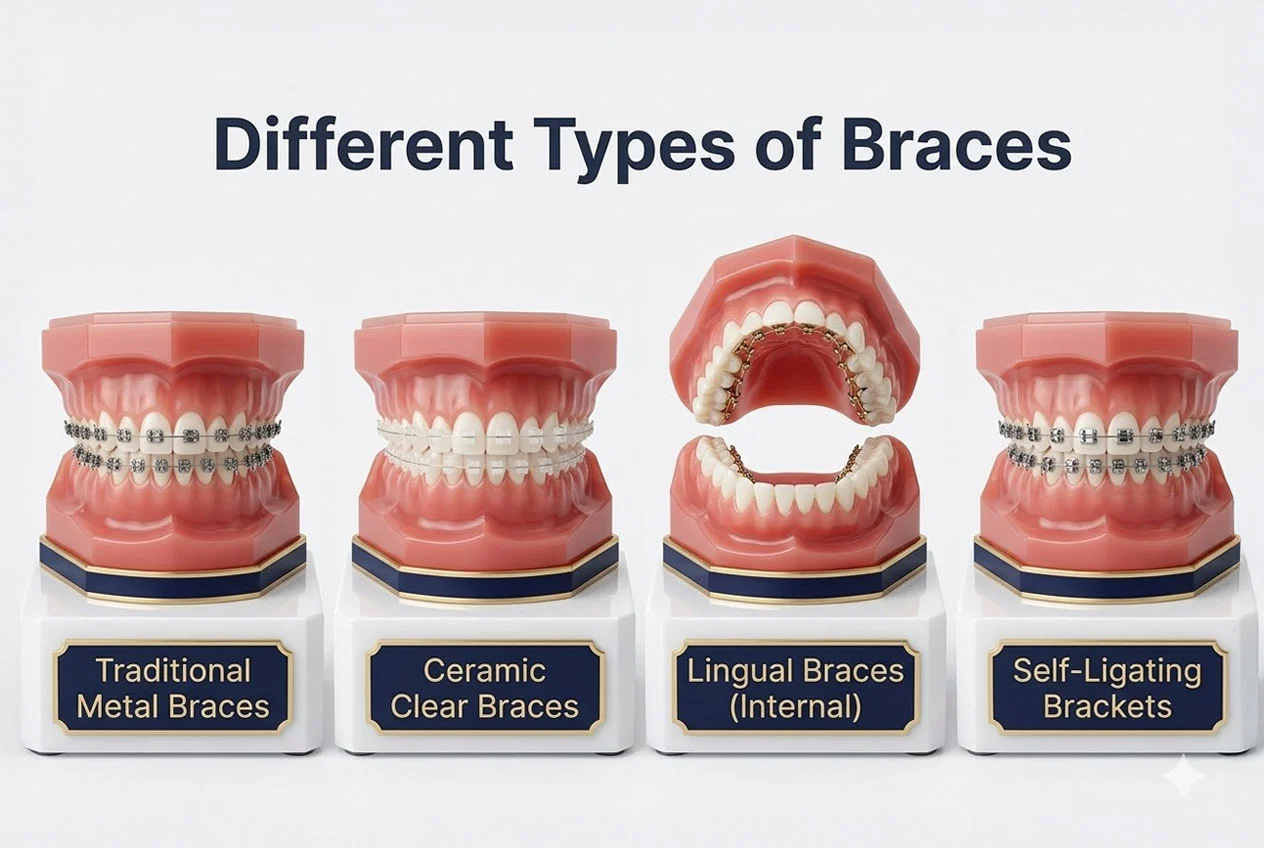
Metal Braces: The most common and cost-effective option features stainless steel brackets and wires. Modern metal braces are smaller and more comfortable than previous generations, though they remain the most visible orthodontic option. They deliver the strongest force application, making them ideal for complex cases requiring significant tooth movement.
Ceramic Braces: These function identically to metal braces but use tooth-colored or clear ceramic brackets that blend with natural tooth enamel. While less noticeable than metal, ceramic brackets are slightly larger and more fragile. They cost moderately more than metal braces and may stain if patients consume highly pigmented foods without proper care.
Lingual Braces: Positioned on the inner (tongue-side) surfaces of teeth, lingual braces remain completely invisible from the front. This premium option appeals to adults seeking discreet treatment, though they require specialized training to place and adjust. Lingual braces typically cost significantly more than standard braces and may temporarily affect speech.
Self-Ligating Braces: Instead of elastic ties, these braces use built-in clips to hold the archwire. Proponents suggest they reduce friction, potentially shortening treatment time and requiring fewer adjustments. Both metal and ceramic self-ligating brackets exist, offering varying degrees of visibility.
What Conditions Do Traditional Braces Treat?
Traditional braces address the full spectrum of orthodontic problems, from simple crowding to severe malocclusions. Their versatility stems from the orthodontist’s ability to apply precise forces in any direction, making them suitable for cases other systems cannot handle.
Severe Crowding: When teeth overlap significantly due to insufficient jaw space, braces can either create space through expansion or work in conjunction with strategic extractions to achieve proper alignment.
Complex Bite Issues: Overbites, underbites, crossbites, and open bites all respond well to braces. The system allows orthodontists to reposition not just individual teeth but entire dental arches relative to each other.
Rotation and Angulation: Teeth that have rotated significantly or tilted at incorrect angles require the three-dimensional control that brackets and wires provide. Braces can torque teeth into proper orientation more effectively than removable aligners.
Vertical Discrepancies: When teeth erupt to different heights, creating an uneven smile line, braces can intrude or extrude individual teeth to establish harmonious proportions.
Midline Corrections: Significant shifts of the dental midline relative to facial centerlines often require the anchorage control that fixed braces provide.
Understanding Invisalign: Modern Clear Aligner Technology
Invisalign revolutionized orthodontics by introducing a nearly invisible alternative to traditional braces. Since its FDA approval in 1998, clear aligner technology has evolved dramatically, expanding its treatment capabilities while maintaining its aesthetic advantages.
How Invisalign Works
Invisalign uses a series of custom-made, clear plastic aligners that fit snugly over your teeth. Each aligner in the sequence applies specific forces to specific teeth, moving them incrementally toward their final positions. You wear each aligner set for approximately 1-2 weeks before progressing to the next in the series.
The process begins with digital scans or impressions of your teeth. Advanced software creates a 3D model and simulates the entire treatment, showing the predicted final result before you even begin. The software divides tooth movements into small steps, with each aligner responsible for one step in the journey.
Small tooth-colored attachments (buttons) bond to certain teeth, providing the aligners with leverage points to apply forces more effectively. These attachments are barely visible but crucial for achieving complex movements. The aligners must be worn 20-22 hours daily, removed only for eating, drinking anything other than water, and oral hygiene.
Invisalign Treatment Variations
Invisalign Comprehensive: The full treatment system handles moderate to complex orthodontic cases. Patients receive an unlimited number of aligners throughout treatment, allowing for mid-course corrections and refinements until the orthodontist and patient achieve satisfaction with results.
Invisalign Lite: Designed for mild to moderate cases, this option provides up to 14 aligner sets over approximately 7 months. It suits patients requiring minor crowding correction or space closure rather than comprehensive alignment.
Invisalign Express: The most limited option addresses very minor misalignments with up to 7 aligner sets over 3-4 months. It works for patients with minimal spacing or crowding who previously wore braces but experienced minor relapse.
Invisalign Teen: Specially designed for adolescent patients, this version includes compliance indicators that fade with wear, helping parents and orthodontists ensure teens wear aligners as prescribed. It also includes eruption tabs that accommodate molars still emerging and provides replacement aligners for those inevitably lost by teenagers.
What Conditions Does Invisalign Treat?
Invisalign’s treatment capabilities have expanded significantly since its introduction. While it initially handled only simple cases, current technology addresses many moderate and some complex orthodontic problems.
Mild to Moderate Crowding: When teeth overlap moderately, Invisalign can create space through expansion or controlled interproximal reduction (IPR), where tiny amounts of enamel are removed between teeth to create room.
Spacing Issues: Gaps between teeth respond particularly well to Invisalign. The aligners can close spaces efficiently without the food-trapping concerns that sometimes occur with braces.
Mild to Moderate Bite Issues: Certain overbites, underbites, and crossbites fall within Invisalign’s capabilities, though severe skeletal discrepancies typically require traditional braces or surgical intervention.
Previous Orthodontic Relapse: Adults who wore braces years ago but experienced tooth shifting make ideal Invisalign candidates. Minor to moderate relapse cases achieve excellent results with clear aligners.
Pre-Prosthetic Orthodontics: Patients needing minor tooth repositioning before receiving crowns, bridges, or implants benefit from Invisalign’s precision and aesthetics.
Detailed Comparison: Invisalign vs Traditional Braces
Understanding how these systems differ across multiple dimensions helps you evaluate which aligns better with your priorities and circumstances.
Aesthetics and Visibility
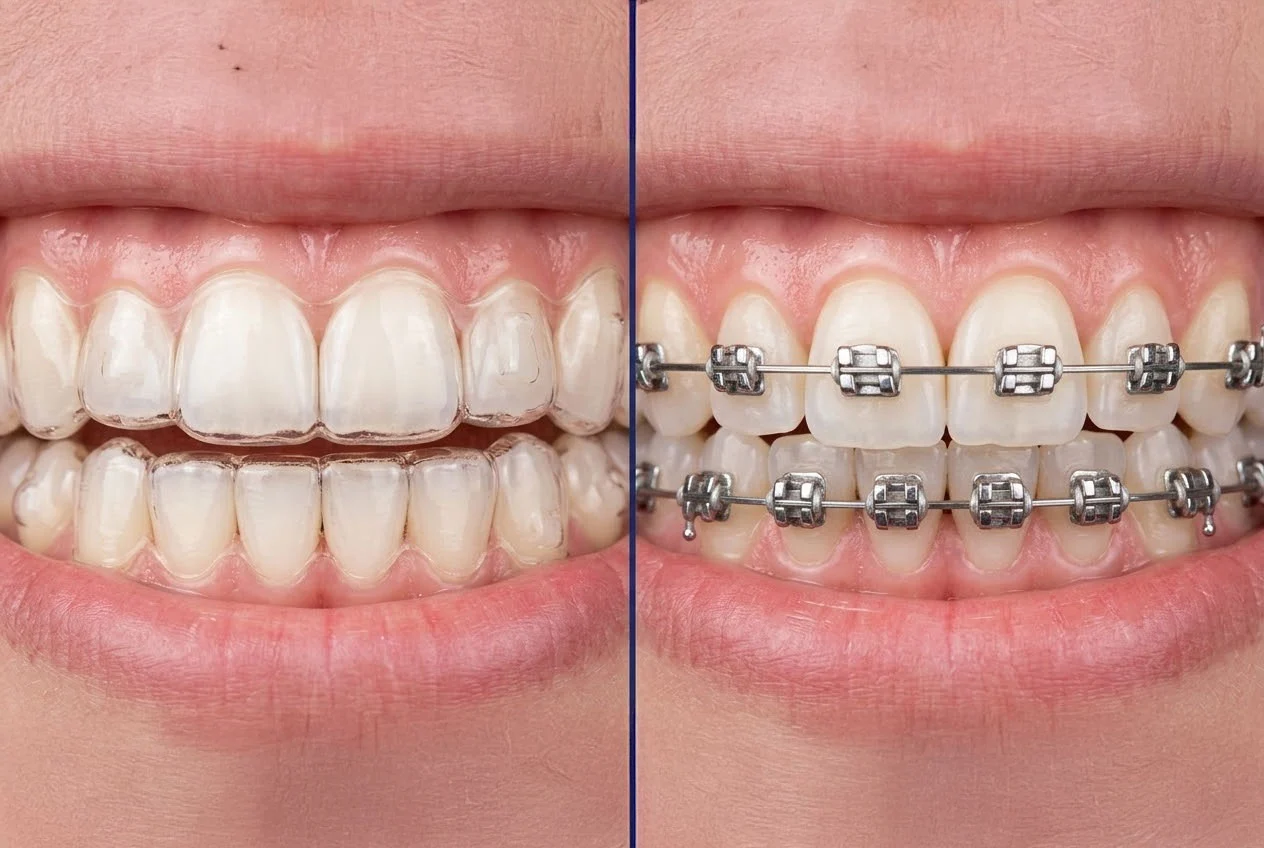
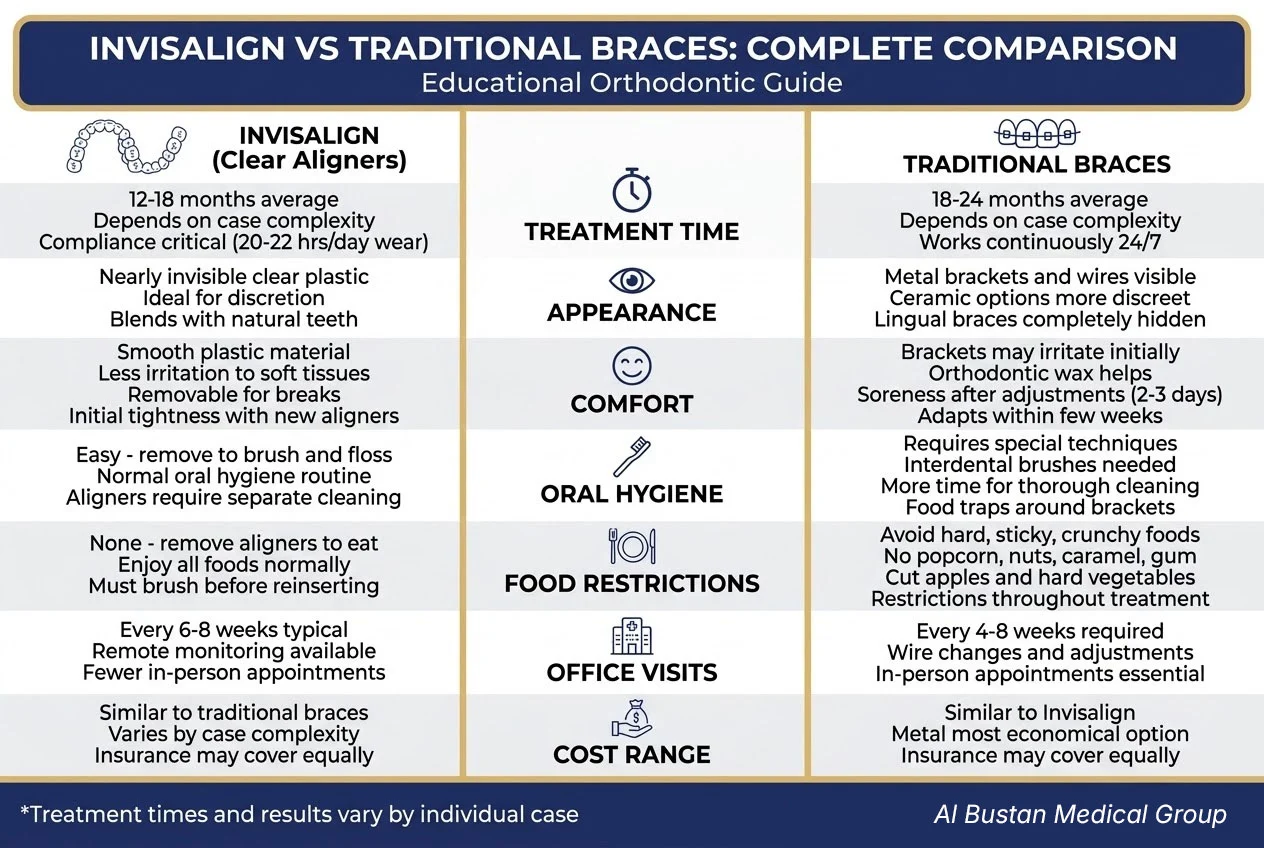
Invisalign: The defining advantage of Invisalign is near-invisibility. Clear plastic aligners blend with teeth, making them virtually undetectable in normal social situations. Most people won’t notice you’re undergoing orthodontic treatment unless you mention it. This discretion particularly appeals to adults and image-conscious professionals.
Traditional Braces: Metal braces are conspicuously visible, especially when smiling or talking. Ceramic braces improve aesthetics significantly, blending better with tooth color, though metal wires remain partially visible. Lingual braces offer complete invisibility but cost considerably more and present functional challenges.
Verdict: Invisalign wins decisively on aesthetics for most patients, though lingual braces match its invisibility at premium pricing.
Comfort and Adaptation
Invisalign: Aligners feel smooth against lips and cheeks, eliminating the irritation that brackets and wires can cause. Initial tightness occurs when switching to new aligners, typically lasting 1-2 days, but sharp edges and painful pressure points are rare. The removable nature allows occasional breaks if needed, though this compromises treatment progress.
Traditional Braces: Brackets may rub against cheek and lip tissue, particularly during the first few weeks. Orthodontic wax provides temporary relief. Archwire adjustments cause generalized soreness for 2-3 days as teeth respond to new pressures. Broken brackets or protruding wires occasionally create urgent discomfort requiring repair appointments.
Verdict: Invisalign generally provides superior comfort, though pain tolerance varies individually and both systems cause some discomfort during active tooth movement.
Treatment Duration
Invisalign: Treatment typically spans 6-18 months depending on case complexity and patient compliance. Simple spacing or mild crowding may resolve in 6-12 months, while more involved cases extend to 18 months or occasionally longer. Compliance critically affects duration—wearing aligners less than prescribed 20-22 hours daily significantly extends treatment.
Traditional Braces: Average treatment lasts 18-24 months, though simple cases may finish in 12-15 months while severe malocclusions can require 24-36 months. Duration depends on the amount of tooth movement needed, not patient compliance, since braces work continuously.
Verdict: Treatment length depends more on case complexity than the chosen system, though Invisalign can be faster for mild to moderate cases when patients maintain excellent compliance.
Eating and Diet Restrictions
Invisalign: Remove aligners before eating or drinking anything except water. This freedom means no food restrictions—you can eat whatever you want. Simply brush your teeth before reinserting aligners. However, this removal requirement makes snacking throughout the day impractical, as it requires multiple brushing sessions.
Traditional Braces: Sticky, hard, and crunchy foods pose risks. Caramels, toffees, hard candies, popcorn, nuts, raw carrots, and similar items can break brackets or bend wires. You must cut apples, corn on the cob, and hard vegetables into small pieces. These restrictions persist throughout treatment.
Verdict: Invisalign provides complete dietary freedom, while braces require ongoing food modifications.
Oral Hygiene and Maintenance
Invisalign: Remove aligners to brush and floss normally, maintaining your pre-treatment hygiene routine. Clean aligners daily with gentle brushing and mild soap or specialized cleaning crystals. The removability makes thorough cleaning straightforward, reducing cavity and gum disease risks compared to braces.
Traditional Braces: Brushing around brackets and wires requires special techniques, additional time, and interdental brushes or floss threaders. Food particles trap easily around brackets, demanding meticulous cleaning after every meal. Inadequate hygiene leads to white spot lesions (permanent decalcification marks) or cavities around brackets.
Verdict: Invisalign dramatically simplifies oral hygiene, making it easier to maintain dental health during orthodontic treatment.
Office Visits and Monitoring
Invisalign: Appointments occur every 6-12 weeks for progress checks and new aligner distribution. Many orthodontists now offer remote monitoring through smartphone apps, allowing you to submit photos between appointments and receive guidance without office visits. This reduces the total number of clinic trips required.
Traditional Braces: Regular adjustment appointments every 4-8 weeks are essential for wire changes and tension modifications. Missing appointments delays progress, as braces cannot advance without professional adjustments. Emergency visits occasionally become necessary if brackets break or wires cause injury.
Verdict: Invisalign requires fewer appointments and offers remote monitoring options, providing greater scheduling flexibility.
Treatment Versatility and Limitations
Invisalign: Best suited for mild to moderate orthodontic issues in compliant patients. Limitations include: difficulty rotating rounded teeth (canines, premolars), challenges correcting severe overbites or underbites, inability to vertically move teeth as precisely as braces, and dependency on patient compliance. Complex cases may require braces or a hybrid approach.
Traditional Braces: Handle virtually any orthodontic problem from simple to extremely complex. Orthodontists control tooth movement in all three dimensions with precision. Severe jaw discrepancies, significant rotations, vertical corrections, and comprehensive bite reconstruction all fall within braces’ capabilities. Patient compliance affects comfort but not treatment effectiveness.
Verdict: Traditional braces offer superior versatility for complex cases, while Invisalign excels within its moderate-complexity sweet spot.
The Treatment Journey: What to Expect
Understanding the step-by-step process for each system helps you prepare for what lies ahead.
Invisalign Treatment Process
1. Initial Consultation: Your orthodontist examines your teeth, takes photographs and radiographs, and discusses your goals. They determine whether Invisalign can achieve your desired results and explain what treatment would entail.
2. Digital Scanning and Treatment Planning: Digital intraoral scanning captures precise 3D models of your teeth. The orthodontist uses specialized software to virtually plan your treatment, showing you a simulation of expected results. You review and approve this virtual treatment plan before proceeding.
3. Aligner Fabrication: Invisalign’s laboratory manufactures your complete set of custom aligners based on the approved treatment plan. Production typically takes 2-3 weeks.
4. Attachment Placement: Small tooth-colored composite buttons bond to specific teeth, providing aligners with leverage points. Your orthodontist precisely positions these attachments according to the digital treatment plan.
5. Aligner Delivery and Instructions: You receive your first several aligner sets with detailed wearing and care instructions. The orthodontist ensures aligners fit properly and teaches you how to insert and remove them correctly.
6. Active Treatment: You progress through aligner sequences at home, wearing each set 20-22 hours daily and changing to the next set every 1-2 weeks as directed. Remote monitoring or periodic office visits track your progress.
7. Mid-Treatment Refinements: If teeth aren’t tracking as predicted, your orthodontist may order refinement aligners to correct the course. These additional aligners extend treatment but ensure optimal results.
8. Treatment Completion and Retention: After finishing your final aligner set and achieving the planned result, you transition to retainers that maintain your new tooth positions indefinitely.
Traditional Braces Treatment Process
1. Initial Consultation and Records: Comprehensive examination includes photographs, radiographs, and dental impressions. Your orthodontist analyzes these records to formulate a detailed treatment plan.
2. Pre-Treatment Preparation: Any necessary dental work (cavity fillings, gum treatment, extractions) must be completed before braces placement to ensure a healthy foundation.
3. Separator Placement: Small elastic rings placed between back teeth for one week create space for molar bands to fit.
4. Bonding Appointment: The orthodontist bonds brackets to tooth surfaces using special adhesive, fits molar bands, and threads the initial archwire through brackets. This appointment typically lasts 60-90 minutes. Teeth feel pressure immediately as the wire begins working.
5. Regular Adjustment Appointments: Every 4-8 weeks, you return for wire changes and adjustments. The orthodontist evaluates progress, changes to progressively stronger wires, and may add elastics or springs to address specific movement needs.
6. Active Treatment Phase: You maintain meticulous oral hygiene, avoid prohibited foods, and attend all scheduled appointments. Treatment gradually progresses as teeth move into planned positions.
7. Finishing and Detailing: Final appointments focus on perfecting tooth positions, bite relationships, and smile aesthetics. The orthodontist ensures everything aligns precisely before removal.
8. Debonding and Retention: Brackets are carefully removed, adhesive polished from teeth, and impressions taken for retainers. You immediately receive retainers to maintain your new smile.
Cost Considerations: Investment in Your Smile
Both orthodontic systems represent significant investments in your oral health and confidence. Understanding cost factors helps you budget appropriately and evaluate value.
Factors Affecting Treatment Cost
Case Complexity: Simple spacing or mild crowding costs less than comprehensive bite correction involving multiple teeth. The number of teeth requiring movement, severity of misalignment, and presence of bite problems all influence pricing.
Treatment Duration: Longer treatment typically costs more due to extended monitoring, additional appointments, and more materials. A 12-month case generally costs less than a 24-month case of similar complexity.
Provider Experience and Location: Specialist orthodontists often charge more than general dentists offering orthodontic services, reflecting their advanced training and expertise. Premium locations like Al Bustan Western Medical Center may have different fee structures than general clinics.
Technology and Materials: Ceramic braces cost more than metal due to material expenses. Self-ligating brackets carry premium pricing. Invisalign’s proprietary technology and custom manufacturing create higher base costs than conventional braces.
Invisalign vs Braces: Cost Comparison
In Abu Dhabi’s orthodontic market, Invisalign and traditional braces often fall within similar price ranges for comparable cases, though specific costs vary by provider and case complexity.
Traditional Metal Braces: Generally represent the most economical option among all orthodontic systems. Their lower material and production costs make them accessible to more patients.
Ceramic Braces: Cost moderately more than metal braces due to more expensive materials and slightly higher breakage rates requiring replacement brackets.
Invisalign: Pricing typically falls between metal and ceramic braces for simple cases but can exceed ceramic braces for complex cases requiring many refinement aligners. The convenience and aesthetics justify the premium for many patients.
Lingual Braces: Command the highest prices due to specialized training requirements, custom manufacturing, and challenging placement procedures.
Insurance and Payment Considerations
Orthodontic insurance coverage varies significantly by plan, and not all dental insurance policies include orthodontic benefits. While many employer-sponsored or premium dental plans offer partial coverage for braces and Invisalign, basic or affordable dental plans often exclude orthodontic services entirely.
When orthodontic coverage exists, plans typically provide:
• Partial Cost Coverage: Most plans cover 25-50% of treatment costs rather than the full amount
• Lifetime Maximum Benefit: A one-time cap (commonly $1,000-$3,000) that applies to orthodontic treatment over your lifetime
• Equal Treatment of Systems: Plans that cover orthodontics typically treat braces and Invisalign equally, applying the same benefit to either system
• Age Restrictions: Coverage for children and teenagers (under age 18-19) is more common than adult orthodontic benefits
• Waiting Periods: Many plans require 6-24 months of coverage before orthodontic benefits become active
Important considerations: Orthodontic coverage is typically listed separately from general dental benefits (cleanings, fillings). The distinction between “cosmetic” and “medically necessary” treatment rarely affects coverage—what matters is whether your specific plan includes orthodontic benefits at all.
At Al Bustan Medical Group locations, our staff verifies your insurance coverage before treatment begins, determines your exact benefits and out-of-pocket costs, and provides detailed cost breakdowns so you understand your investment completely. If your insurance doesn’t cover orthodontics or provides limited benefits, we offer flexible payment solutions.
Payment plans make orthodontic treatment accessible by spreading costs over the treatment duration. Monthly payment arrangements help families manage expenses comfortably, ensuring financial considerations don’t prevent you from achieving your ideal smile.
Determining Your Best Option: Candidacy and Suitability
While patient preference matters, clinical factors ultimately determine which system best suits your situation.
You May Be an Ideal Invisalign Candidate If:
✓ Your orthodontic needs fall into the mild to moderate complexity range
✓ Aesthetics and discretion are high priorities
✓ You can commit to wearing aligners 20-22 hours daily without exception
✓ You have good oral hygiene habits you’ll maintain throughout treatment
✓ Your work or lifestyle makes frequent eating or aligner removal practical
✓ You’re responsible enough to track aligner sequences and progression
✓ You want fewer office appointments and appreciate remote monitoring
✓ You’re an adult or mature teenager who will follow treatment protocols
You May Be an Ideal Traditional Braces Candidate If:
✓ Your orthodontic case involves significant complexity
✓ You have severe crowding, major bite issues, or extensive rotations
✓ You’re a young teenager who might struggle with aligner compliance
✓ You prefer treatment that works continuously regardless of your actions
✓ You don’t mind the appearance of braces during treatment
✓ Cost is a primary consideration and you want the most economical option
✓ You’re comfortable with dietary modifications during treatment
✓ Your insurance provides better coverage for braces than aligners
Situations Where Braces May Be Necessary:
Certain orthodontic challenges exceed Invisalign’s capabilities, requiring the precision and force control that only braces provide:
Severe Skeletal Discrepancies: Significant jaw size mismatches often require braces combined with surgical intervention or functional appliances.
Large Vertical Movements: Significant intrusion (pushing teeth upward into bone) or extrusion (pulling teeth downward) works better with braces’ direct force application.
Tooth Shape Issues: Short, rounded, or peg-shaped teeth lack surface area for aligners to grip effectively, making bracket bonding more reliable.
Compliance Concerns: If the orthodontist or patient has doubts about wearing aligners consistently, braces eliminate compliance as a variable.
Making Your Decision: A Framework
Several key questions help clarify which treatment aligns with your needs:
How complex is my orthodontic situation? Your orthodontist’s assessment carries more weight than personal preference. Respect professional guidance on whether your case suits Invisalign’s capabilities.
What matters most to me during treatment? Rank your priorities: aesthetics, comfort, convenience, dietary freedom, treatment speed, or cost. Your priority hierarchy points toward the better choice.
Can I commit to 20-22 hours daily aligner wear? Be brutally honest. If you frequently forget to wear retainers or struggle with self-discipline, braces’ non-removable nature might serve you better.
How does my lifestyle align with each system? Consider your professional environment, social situations, dietary habits, and schedule flexibility. Some careers favor Invisalign’s discretion; others make frequent aligner removal impractical.
What does my orthodontist recommend? Experienced specialists can predict which system will deliver superior results for your specific case. Their recommendation should carry significant weight.
Orthodontic Excellence at Al Bustan Medical Group
For 18 years, Al Bustan Medical Group has provided comprehensive orthodontic care to Abu Dhabi families. Our MOHAP-licensed orthodontic specialists bring extensive experience with both traditional braces and Invisalign, ensuring you receive honest guidance on which system suits your needs best.
Our Orthodontic Specialists
Six specialist orthodontists across our nine Abu Dhabi locations provide personalized orthodontic care:
At Al Bustan Medical Center (Khalifa City): Dr. Niveditha Shetty and Dr. Lubna Ibrahim offer comprehensive orthodontic solutions for all ages.
At Al Bustan Western Medical Center: Dr. Kinan Salloum and Dr. Modar Ibrahim specialize in adult orthodontics and aesthetic alignment solutions.
Multiple orthodontists mean families with several children seeking treatment can often schedule concurrent appointments, minimizing time commitment and maximizing convenience.
Comprehensive Treatment Planning
Your orthodontic journey begins with thorough evaluation using advanced diagnostic technology. Digital radiography, intraoral scanning, and photographic documentation create a complete picture of your orthodontic needs. We explain findings clearly, present available treatment options, and collaboratively develop a plan aligned with your goals and circumstances.
Whether you choose Invisalign or traditional braces, you receive the same level of expertise, attention to detail, and commitment to exceptional results. We don’t push one system over another—we recommend what genuinely serves your best interests.
Flexible Locations and Scheduling
With nine centers across Abu Dhabi including convenient locations in Khalifa City, Al Shahama, and beyond, you can choose the most accessible location for your regular appointments. Extended hours—9:00 AM to 10:00 PM daily—accommodate work schedules and family commitments.
Your treatment records synchronize across our network, allowing appointment flexibility if your circumstances change. Start treatment at one location and continue at another if needed—your care remains seamless regardless of which center you visit.
Life After Treatment: Retention and Long-Term Results
Regardless of whether you choose Invisalign or braces, treatment success depends heavily on proper retention. Teeth naturally want to drift back toward their original positions, especially in the first year after active treatment. Retainers prevent this relapse, protecting your investment.
Types of Retainers
Fixed Retainers: Thin wires bonded to the back surfaces of front teeth provide permanent retention for critical areas. They work 24/7 without requiring patient compliance, making them ideal for preventing front teeth from shifting.
Removable Clear Retainers: Similar to Invisalign aligners, these clear plastic retainers fit over teeth and should be worn full-time initially, then nightly long-term. They’re comfortable and nearly invisible but require patient compliance.
Hawley Retainers: Traditional retainers featuring acrylic and metal wire remain highly effective. While more visible than clear retainers, they’re durable and adjustable if minor tooth movement occurs.
Retention Protocol
Most orthodontists recommend wearing removable retainers full-time for the first 3-6 months after completing active treatment. This initial period is critical—teeth move most easily right after braces or aligners finish their work.
After this intensive retention phase, transition to nighttime wear indefinitely. Many orthodontists suggest lifelong nightly retention to guarantee results remain stable decades later. This small nightly commitment preserves years of orthodontic work.
Frequently Asked Questions: Invisalign vs Traditional Braces
Q: Is Invisalign as effective as traditional braces?
For the cases it can treat (mild to moderate complexity), Invisalign achieves results comparable to braces when patients maintain excellent compliance. However, braces remain superior for complex cases involving severe crowding, significant bite issues, or extensive tooth rotations. Your orthodontist’s assessment determines whether your specific situation suits Invisalign’s capabilities.
Q: How long does Invisalign treatment take compared to braces?
Treatment duration depends more on case complexity than the chosen system. Simple Invisalign cases may finish in 6-12 months, while complex braces cases can require 24-36 months. For similar moderate-complexity cases, Invisalign can be faster (12-18 months) than braces (18-24 months) when patients maintain perfect compliance, wearing aligners 22 hours daily.
Q: Can I eat normally with Invisalign?
Yes—you remove Invisalign aligners before eating or drinking anything except water, allowing you to enjoy any foods without restriction. However, you must brush your teeth before reinserting aligners, making frequent snacking impractical. With braces, you can eat anytime but must avoid sticky, hard, and crunchy foods that could damage brackets or wires.
Q: Does Invisalign hurt less than braces?
Both systems cause some discomfort as teeth move, though the nature differs. Invisalign creates pressure and tightness when switching to new aligners, typically lasting 1-2 days. Braces cause soreness after adjustments lasting 2-3 days, plus potential irritation from brackets and wires rubbing soft tissues. Most patients find Invisalign more comfortable overall, though individual pain tolerance varies.
Q: Can adults get Invisalign or are braces better?
Adults are excellent candidates for either system, with choice depending on clinical needs and personal preferences. Many adults prefer Invisalign for its discretion in professional environments. However, if your orthodontic case is complex, braces might deliver superior results regardless of age. Both systems work equally well on adult teeth.
Q: What happens if I lose an Invisalign aligner?
Contact your orthodontist immediately. Options include: wearing the previous aligner until a replacement arrives, moving to the next aligner in sequence if you’ve worn the lost one long enough, or ordering a replacement aligner (typically taking 1-2 weeks). Some orthodontists provide backup aligners to prevent treatment delays from loss.
Q: Are ceramic braces as strong as metal braces?
Ceramic braces function identically to metal braces and deliver equivalent results. However, ceramic brackets are slightly more fragile and may chip or break if subjected to significant force. They also stain if patients consume highly pigmented foods without proper oral hygiene. Metal braces resist breakage better and don’t discolor.
Q: Can I switch from braces to Invisalign mid-treatment?
In some cases, yes. If you’ve made significant progress with braces, your orthodontist might be able to remove them and complete treatment with Invisalign. However, this depends on remaining tooth movements needed and whether they fall within Invisalign’s capabilities. Discuss this possibility with your orthodontist if you’re unhappy with braces.
Q: Do I need to see an orthodontist or can a general dentist provide treatment?
Both specialist orthodontists and specially trained general dentists can provide orthodontic treatment. However, orthodontists complete 2-3 years of additional training beyond dental school, focusing exclusively on tooth movement and bite correction. For complex cases, specialist expertise often produces superior results. Simple cases may be suitable for general dentists with orthodontic training.
Q: Will my teeth stay straight forever after treatment?
Teeth naturally tend to shift throughout life due to aging, jaw growth changes, and daily forces from chewing and speaking. Wearing retainers as prescribed—typically nightly long-term—maintains your orthodontic results indefinitely. Without retention, some degree of relapse is nearly inevitable, regardless of whether you had braces or Invisalign.
Q: How do I choose between Invisalign and braces at Al Bustan Medical Group?
Schedule a consultation at any of our nine Abu Dhabi locations. Our orthodontists will examine your teeth, discuss your goals and concerns, explain which systems can achieve your desired results, and present recommendations based on clinical factors and your preferences. Call 8007755 or book online to begin your orthodontic journey.
Q: Does insurance cover Invisalign the same as braces in Abu Dhabi?
Coverage depends entirely on whether your dental insurance plan includes orthodontic benefits, as not all plans do. When orthodontic coverage exists, most plans treat Invisalign and braces equally, applying the same percentage coverage and lifetime maximum to either system. However, many basic or affordable dental plans exclude orthodontic services entirely. Coverage for children is more common than adult orthodontic benefits. Our staff verifies your specific insurance coverage and determines your exact benefits regardless of which treatment you choose.
Taking Your Next Step
The decision between Invisalign and traditional braces ultimately depends on your unique orthodontic needs, lifestyle requirements, and personal priorities. Neither system is universally “better”—each excels in different situations and serves different patient populations.
What matters most is choosing a qualified orthodontist who offers both options, honestly assesses which system suits your case, and possesses the expertise to deliver excellent results with either. At Al Bustan Medical Group, our MOHAP-licensed specialists provide exactly this comprehensive, patient-centered approach.
Ready to explore your orthodontic options? Contact any of our nine Abu Dhabi locations to schedule a consultation. Call 8007755 or book online. We’ll help you choose the orthodontic path that leads to your best smile.
Al Bustan Medical Group: 18 years of trusted orthodontic care, nine convenient locations across Abu Dhabi, MOHAP-licensed specialists, comprehensive treatment options. Your smile transformation begins here.