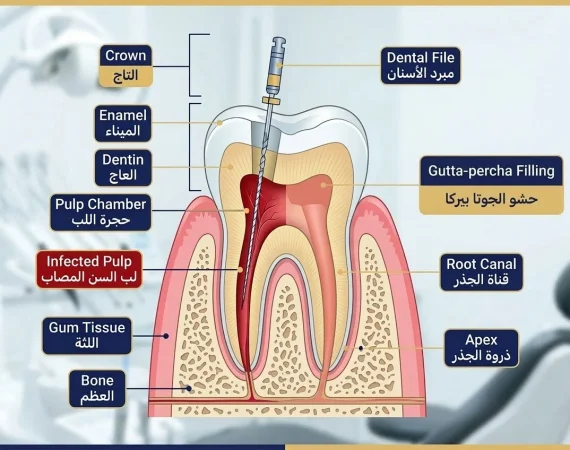
Missing teeth can significantly impact your quality of life, affecting everything from your ability to eat and speak comfortably to your confidence in social situations. If you’re considering tooth replacement options in Abu Dhabi, dental implants represent the gold standard in modern dentistry—offering a permanent, natural-looking solution that can last a lifetime with proper care.
At Al Bustan Medical Center, we’ve helped thousands of patients across Abu Dhabi restore their smiles through advanced implant dentistry. With modern immediate loading techniques, many patients now qualify for same-day teeth, walking out of our clinic with a functional smile on the same day as implant surgery. Whether you’re missing a single tooth, multiple teeth, or require full-mouth restoration, this comprehensive guide will walk you through everything you need to know about dental implants: the types available, same-day vs. traditional timelines, the procedure process, expected costs in Abu Dhabi, and what to expect during recovery.
Quick Fact: Dental implants have a success rate of over 95% and can last 25 years or longer with proper maintenance, making them the most durable tooth replacement option available today.
What Are Dental Implants?
Dental implants are artificial tooth roots made from biocompatible titanium that are surgically placed into your jawbone. Unlike dentures or bridges that sit on top of your gums, implants integrate with your bone through a process called osseointegration, creating a stable foundation that mimics your natural tooth structure.
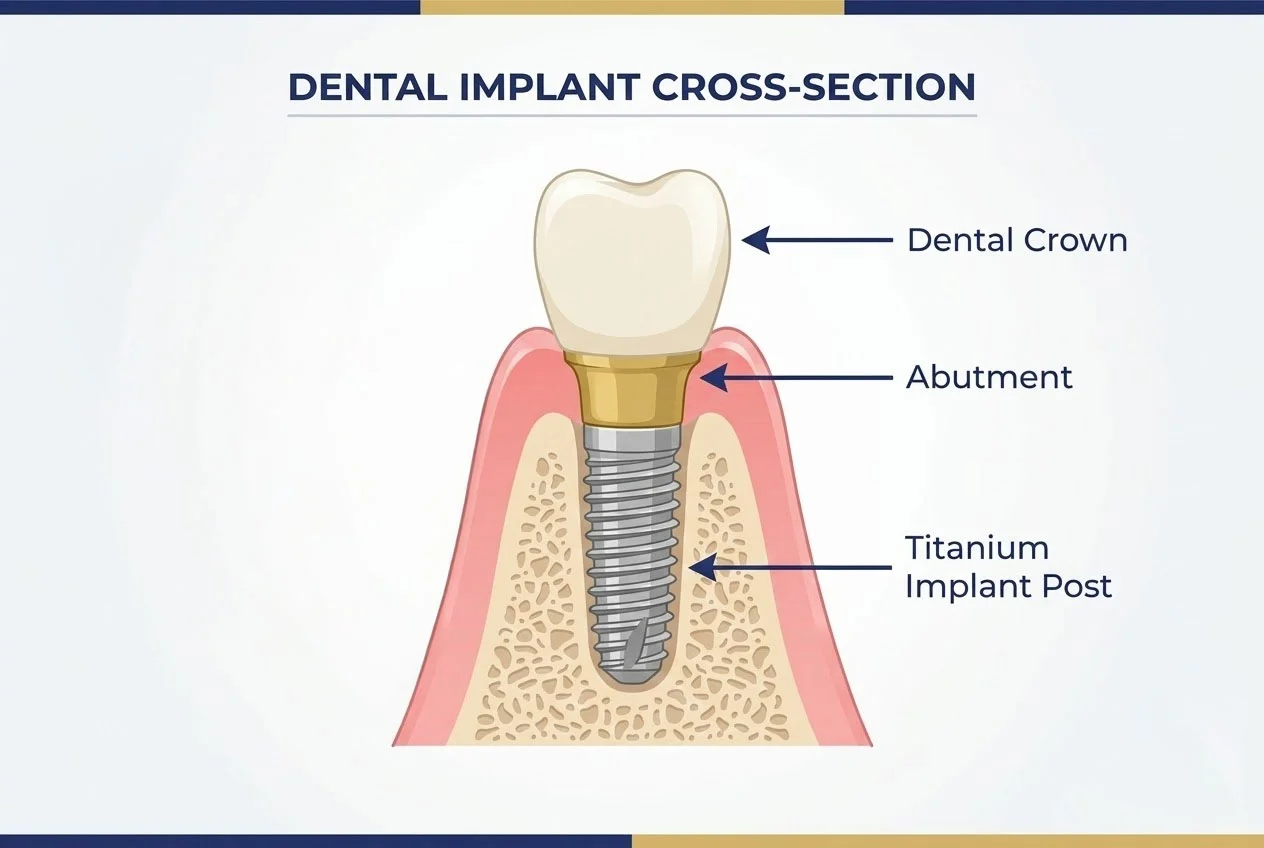
The Three Components of a Dental Implant
A complete dental implant system consists of three parts:
- The Implant Post: A titanium screw that serves as the artificial root, surgically inserted into the jawbone
- The Abutment: A connector piece that attaches to the implant post and holds the crown
- The Crown: The visible portion that looks like a natural tooth, custom-made to match your existing teeth
This three-part system allows dental implants to function just like natural teeth, distributing bite forces properly and preventing bone loss that typically occurs after tooth extraction.
Types of Dental Implants Available in Abu Dhabi
At Al Bustan Medical Center, we offer several types of dental implant solutions tailored to your specific needs, bone structure, and budget. Understanding the different options will help you make an informed decision about your treatment.
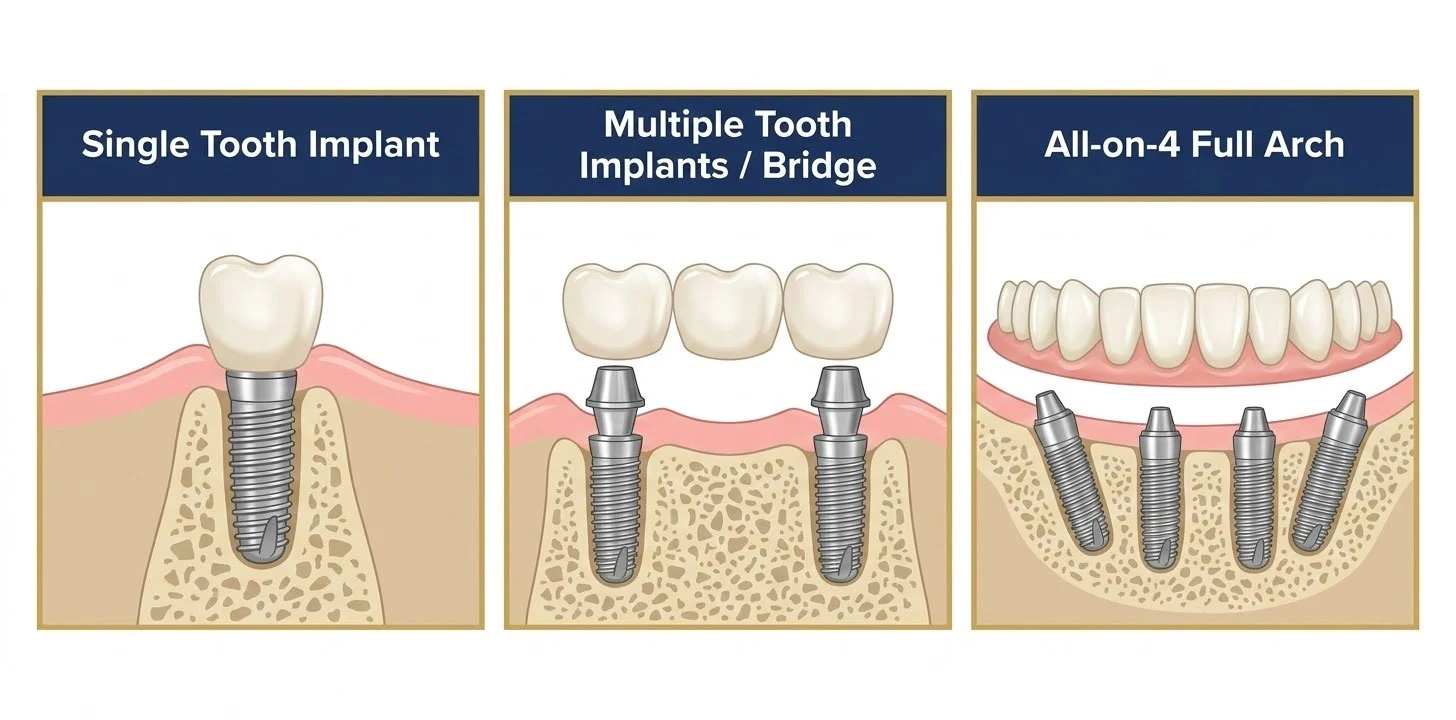
1. Single Tooth Implants
The most common type, single tooth implants are ideal for replacing one missing tooth. The implant post is placed in the jawbone where the natural tooth root was located, and a custom crown is attached. This solution preserves the adjacent healthy teeth, as no grinding or alteration is needed (unlike traditional bridges).
Best for: Patients missing one tooth due to injury, decay, or congenital absence
2. Multiple Tooth Implants (Implant-Supported Bridges)
When you’re missing several adjacent teeth, an implant-supported bridge uses two or more implants to support multiple crowns. This is more stable than traditional bridges and doesn’t require support from natural teeth.
Best for: Patients missing 2-4 consecutive teeth
3. All-on-4 Dental Implants
All-on-4 is a revolutionary technique that uses just four strategically placed implants to support a full arch of replacement teeth (upper or lower). The implants are positioned at precise angles to maximize contact with existing bone, often eliminating the need for bone grafting.
Best for: Patients missing most or all teeth in one arch, or those with significant bone loss
Key advantage: Full-mouth restoration in a single day with immediate temporary teeth
4. All-on-6 Dental Implants
Similar to All-on-4 but using six implants for additional stability and support. This option is recommended for patients who need maximum strength for chewing or have more bone volume available.
Best for: Full-arch restoration with enhanced stability
5. Mini Dental Implants
Mini implants are smaller in diameter than traditional implants and are primarily used to stabilize dentures or in areas with limited space. They’re less invasive and typically heal faster.
Best for: Stabilizing lower dentures, narrow spaces, or patients who cannot undergo extensive surgery
Endosteal vs. Subperiosteal Implants
These classifications refer to placement method:
- Endosteal Implants: The most common type, placed directly into the jawbone (includes all types mentioned above)
- Subperiosteal Implants: Placed on top of the jawbone but under the gum tissue, used only when insufficient bone height exists and bone grafting isn’t an option
Why Choose Dental Implants? 8 Life-Changing Benefits
Dental implants offer advantages that go far beyond aesthetics. Here’s why they’re considered the superior choice for tooth replacement:
- Natural Look and Feel: Implants are designed to look, feel, and function exactly like your natural teeth. Most people won’t even know you have them.
- Prevents Bone Loss: When you lose a tooth, the jawbone begins to deteriorate from lack of stimulation. Implants are the only tooth replacement option that preserves and stimulates bone growth.
- Protects Healthy Teeth: Unlike bridges that require grinding down adjacent healthy teeth, implants stand independently without affecting neighboring teeth.
- Permanent Solution: With proper care, dental implants can last a lifetime. Traditional bridges typically need replacement every 5-10 years, and dentures require regular adjustments.
- Improved Chewing Power: Implants restore up to 80% of your natural chewing force, allowing you to eat your favorite foods without worry.
- Enhanced Speech: Missing teeth or ill-fitting dentures can affect pronunciation. Implants provide stable support for clear speech.
- Easy Maintenance: No special cleaning solutions or adhesives needed—simply brush and floss like natural teeth.
- Facial Structure Preservation: Tooth loss can cause facial sagging and a prematurely aged appearance. Implants maintain your facial contours by supporting the jawbone and surrounding tissues.
READY TO RESTORE YOUR SMILE?
BOOK AN APPOINTMENT
The Dental Implant Procedure: Step-by-Step Process
Modern implant dentistry offers two primary treatment pathways: immediate loading (same-day teeth) and traditional/delayed loading. Understanding both approaches helps set realistic expectations for your treatment.
Two Treatment Timelines Available:
- Immediate Loading (“Teeth in a Day”): Implant placed + temporary crown/teeth attached the same day. Final restoration after 3-6 months healing.
- Traditional Loading: Implant placed, 3-6 months healing period with no crown, then final restoration attached.
Your implant specialist will recommend the best approach based on your bone quality, implant stability, and specific case requirements.
Step 1: Initial Consultation & Assessment (Day 1)
Your journey begins with a comprehensive evaluation including:
- Detailed medical and dental history review
- Clinical examination of your teeth, gums, and bite
- 3D CBCT scan to assess bone density and structure
- Digital impressions and photographs
- Discussion of immediate vs. traditional loading protocols
- Personalized treatment plan and cost estimate
Our implant dentistry specialists will determine if you’re a candidate for same-day teeth or if traditional timing is recommended for optimal results.
Step 2: Preparatory Treatments (If Needed)
Some patients require preparatory procedures before implant placement:
- Tooth Extraction: If the damaged tooth is still present, it can often be removed the same day as implant placement
- Bone Grafting: If bone volume is insufficient (typically extends timeline by 3-6 months)
- Sinus Lift: For upper back teeth where sinus cavity limits bone height
Step 3: Implant Placement Surgery
The surgical procedure typically takes 1-2 hours per implant:
- Local anesthesia administration (sedation options available for anxious patients)
- Precise implant site preparation using digital surgical guides
- Titanium implant post carefully inserted into jawbone
- Primary stability assessment to determine loading protocol eligibility
- FOR IMMEDIATE LOADING: Temporary crown/bridge attached the same day
- FOR TRADITIONAL LOADING: Healing cap placed; gum tissue sutured closed
What Determines If You Can Have Same-Day Teeth?
Immediate loading eligibility depends on several critical factors:
- Primary Stability: The implant must achieve sufficient insertion torque (usually 35+ Ncm) to withstand chewing forces
- Bone Quality: Dense, healthy bone (Type 1 or Type 2) provides better immediate stability than softer bone
- Implant Position: Front teeth are often better candidates than molars due to lower biting forces
- Patient Compliance: Ability to follow soft-food diet and avoid heavy chewing during healing
- Overall Health: No conditions that impair healing (uncontrolled diabetes, heavy smoking)
Success Rates: Clinical studies show immediate loading achieves 90-95% success rates when proper criteria are met, while traditional loading exceeds 95%. Both protocols achieve excellent long-term osseointegration with proper patient selection and care.
Step 4: Healing & Osseointegration Period (3-6 Months)
Regardless of loading protocol, the implant requires 3-6 months to fully fuse with your jawbone through osseointegration. The key difference is what you have during this time:
- Immediate Loading Patients: Wear a temporary crown/prosthesis that looks and feels like a natural tooth, but must follow a modified soft-food diet and avoid direct biting pressure on the implant during early healing (first 6-8 weeks especially critical)
- Traditional Loading Patients: Healing occurs beneath the gum; temporary removable partial denture or nothing (depending on location and aesthetics)
During this period, regular check-ups monitor integration progress and ensure proper healing.
Step 5: Abutment Placement (Traditional Loading Only)
For traditional loading protocol: once osseointegration is complete (3-6 months), a minor procedure exposes the implant and attaches the abutment connector piece.
For immediate loading: the abutment was placed during initial surgery.
Step 6: Final Permanent Restoration
After complete osseointegration:
- Immediate Loading: Temporary crown removed; final custom crown crafted from durable materials (ceramic, zirconia) and permanently cemented
- Traditional Loading: Final crown fabricated and placed for the first time
Your permanent crown is designed to match your natural teeth perfectly and withstand normal chewing forces for decades.
Timeline Comparison:
Immediate Loading: Temporary teeth same day → 3-6 months healing with temporary crown → Final crown placement = Teeth from Day 1
Traditional Loading: Implant surgery → 3-6 months healing period → Abutment placement → Final crown = Total 4-7 months with gap period
Recovery & Aftercare: What to Expect
Immediate Post-Surgery Care (First 48 Hours)
The first two days are critical for successful healing:
- Manage Swelling: Apply ice packs for 20 minutes on, 20 minutes off
- Pain Management: Take prescribed or over-the-counter pain medication as directed
- Rest: Avoid strenuous activities for 3-5 days
- Diet: Stick to soft, cool foods (yogurt, smoothies, mashed potatoes, soup)
- Oral Hygiene: Gentle rinsing with salt water; avoid brushing the surgical site
- No Smoking: Smoking significantly increases implant failure risk
First Week Recovery
- Swelling and bruising peak around day 3, then gradually subside
- Mild discomfort is normal and manageable with medication
- Sutures may dissolve or require removal (typically day 7-10)
- Continue soft food diet
- Resume gentle brushing of other teeth
Long-Term Care for Implant Success
To ensure your implants last a lifetime:
- Excellent Oral Hygiene: Brush twice daily with a soft-bristled toothbrush and floss daily around the implant
- Regular Dental Visits: Professional cleanings every 6 months and check-ups to monitor implant health
- Avoid Hard Foods: Don’t chew ice, hard candy, or use teeth as tools
- No Smoking: Smoking is the leading cause of implant failure
- Wear a Night Guard: If you grind your teeth (bruxism), protect your investment
Warning Signs to Report Immediately:
- Severe pain that doesn’t improve after 3-4 days
- Excessive bleeding
- Fever or signs of infection
- Implant feels loose
- Unusual swelling that worsens after day 3
Understanding Dental Implant Costs in Abu Dhabi
One of the most common questions patients ask is “How much do dental implants cost?” The honest answer is: it depends on your unique situation. At Al Bustan Medical Center, we believe in transparent pricing, which means providing you with an accurate, personalized cost estimate based on your specific needs rather than generic pricing that may not apply to your case.
Understanding Dental Implant Pricing
Dental implant costs vary significantly based on multiple factors specific to each patient’s case. At Al Bustan Medical Center, we provide personalized treatment plans with transparent pricing after a comprehensive consultation and assessment. There is no one-size-fits-all price for implants, as your investment depends on several key variables.
What Determines Your Implant Cost?
| Cost Factor | How It Affects Pricing |
|---|---|
| Type of Implant | Single tooth, multiple teeth, All-on-4, or All-on-6 solutions each have different requirements and complexity levels |
| Implant Brand & Material | Premium internationally recognized systems versus standard quality options; titanium versus zirconia implants; warranty coverage and longevity differences |
| Crown Material | Porcelain-fused-to-metal, all-ceramic, or zirconia crowns have varying costs and aesthetic qualities |
| Specialist Expertise | Experienced implantologists and oral surgeons with advanced training may have different fee structures |
| Case Complexity | Simple straightforward cases versus complex cases requiring additional procedures |
| Additional Procedures | Bone grafting, sinus lift, extractions, or other preparatory treatments if needed |
| Number of Implants | Single tooth versus full-mouth restoration significantly impacts total investment |
| Diagnostic Requirements | 3D CBCT scans, digital impressions, and comprehensive assessments |
Why Pricing Varies Between Patients
Two patients receiving dental implants may have vastly different treatment plans and costs. For example:
- A patient with excellent bone density requiring a single implant will have a simpler, less expensive treatment compared to someone needing bone grafting and multiple implants
- The choice between a standard implant system and a premium brand with lifetime warranty affects the investment
- Different implantologists may have varying fee structures based on their experience, specialization, and expertise level
- Complex cases requiring computer-guided surgery or advanced techniques may involve additional costs
This is why Al Bustan Medical Group provides detailed, personalized treatment plans during your initial consultation. We’ll assess your specific needs, discuss all available options, and provide transparent pricing before you make any commitment.
Insurance Coverage
Many UAE dental insurance plans classify dental implants as elective or cosmetic procedures and may not provide coverage. However, coverage varies by policy:
- Some corporate health plans include partial implant coverage
- Premium insurance policies may cover a portion of the treatment
- Accident-related tooth loss is sometimes covered differently than elective replacement
- Insurance may cover associated procedures like extractions even if implants aren’t covered
Al Bustan Medical Group accepts all major dental insurance providers in the UAE. Our administrative team can help you:
- Verify your coverage and benefits
- Submit claims on your behalf
- Maximize your insurance benefits where applicable
- Provide detailed invoices and treatment documentation
Getting Your Personalized Cost Estimate
The best way to understand your implant investment is through a comprehensive consultation. During your visit, we will:
- Conduct a thorough clinical examination
- Perform necessary diagnostic imaging (3D CBCT scan)
- Assess your bone density and oral health
- Discuss your goals and expectations
- Present treatment options with detailed cost breakdowns
- Provide transparent pricing with no hidden fees
Long-Term Value: While dental implants require a higher initial investment than other tooth replacement options, their longevity (25+ years or lifetime) makes them more economical over time. Unlike bridges that need replacement every 7-10 years or dentures requiring regular adjustments and refitting, implants are a one-time investment in permanent tooth replacement. Schedule a consultation to receive your personalized cost estimate and treatment plan.
Am I a Good Candidate for Dental Implants?
Most adults in good general health can receive dental implants. Here’s what makes an ideal candidate:
Good Candidates:
- Healthy gums free from periodontal disease
- Adequate bone density to support the implant
- Good overall health without uncontrolled chronic conditions
- Commitment to excellent oral hygiene
- Non-smoker or willing to quit
- Realistic expectations about the process and results
Conditions That May Require Special Consideration:
- Diabetes: Well-controlled diabetes is typically not a barrier; uncontrolled diabetes may delay healing
- Osteoporosis: May affect bone quality; often manageable with medication adjustment
- Autoimmune Disorders: Case-by-case evaluation needed
- Radiation Therapy: Jaw radiation may affect implant success
- Heavy Smoking: Significantly increases failure risk; cessation recommended
Age Considerations
There’s no upper age limit for dental implants—only sufficient bone density and good health matter. However, implants aren’t recommended for patients under 18-21 (females/males respectively) as jaw growth must be complete.
NOT SURE IF YOU’RE A CANDIDATE FOR DENTAL IMPLANTS?
BOOK AN APPOINTMENT
Why Choose Al Bustan Medical Group for Dental Implants?
When it comes to a procedure as important as dental implants, choosing the right provider is crucial. Here’s what sets Al Bustan Medical Group apart:
1. Experienced Specialists
Our team includes board-certified implant dentists and oral surgeons with thousands of successful implant placements. We stay current with the latest techniques through continuous education and advanced training.
2. Advanced Technology
- 3D CBCT Scanning: Precise imaging for optimal implant placement
- Computer-Guided Surgery: Enhanced accuracy and minimally invasive procedures
- Digital Impressions: More comfortable and accurate than traditional molds
- In-House Laboratory: Custom crowns crafted to perfection
3. Premium Implant Systems
We use internationally recognized implant systems with proven long-term success rates and comprehensive warranty coverage, ensuring the highest quality for your treatment.
4. Comprehensive Care Under One Roof
From initial consultation to final restoration, all phases of your treatment are completed within our facilities across Abu Dhabi—no need for multiple referrals.
5. Convenient Locations Throughout Abu Dhabi
With 9 clinics strategically located in Khalifa City, Al Shahama (Deerfields Mall), Western Region, and other areas, quality implant dentistry is always nearby.
6. Transparent Pricing & Insurance Assistance
We provide detailed treatment plans with all-inclusive pricing—no surprise costs. Our team helps you understand your insurance coverage and maximizes your benefits where applicable.
Patient Trust: Al Bustan Medical Group has served Abu Dhabi families since 2008 with consistently high patient satisfaction and thousands of successful implant cases across our locations.
UAE Standards for Implant Dentistry: Quality You Can Trust
In the UAE, dental implant procedures are highly regulated to ensure patient safety and treatment quality. Unlike some countries where any dentist can perform implants, the UAE requires specialized credentials—implantology is a privilege that must be specifically added to a dentist’s license through rigorous training and evaluation.
What This Means for Your Safety
At Al Bustan Medical Center, all our implant dentists and oral surgeons have obtained their implantology privilege through:
- Extensive Training Programs: Completion of 18-month to 2-year NIHS-accredited implantology courses with minimum 160 hours of advanced education
- Documented Clinical Experience: Supervised placement of 30+ dental implants on multiple patients with varying complexities
- MOHAP License Approval: Individual license verification and implantology privilege approval by the Ministry of Health and Prevention
- Continuous Practice: Active implant practice maintained without gaps to ensure skill retention
- Ongoing Education: Regular continuing education to stay current with latest techniques and technologies
As leaders in implant education, Al Bustan Medical Group operates an NIHS-accredited Dental Implantology Academy—the Implant Privileges Program—that trains dentists across the UAE to meet these rigorous standards, ensuring our own team and the broader dental community maintain the highest level of expertise.
Specialist-Only Advanced Procedures
UAE healthcare regulations mandate that certain complex implant procedures can only be performed by board-certified specialists:
- Sinus Lift Surgery: Only Oral Surgeons, Maxillofacial Surgeons, or Periodontists
- Advanced Bone Grafting: Restricted to surgical specialists with additional training
- Complex Full-Arch Restorations: Performed by experienced implantologists and prosthodontists working as a team
At Al Bustan Medical Center, we have the full range of specialists in-house across all our locations to handle cases of any complexity—from simple single-tooth replacements to advanced full-mouth reconstructions.
Your Peace of Mind: When you choose Al Bustan Medical Center, you can be confident that your implant treatment is performed by properly licensed, highly trained professionals who meet or exceed all UAE healthcare standards. All 9 of our Abu Dhabi locations are equipped to provide expert implant dentistry.
Frequently Asked Questions About Dental Implants
Q1: How painful is the dental implant procedure?
Most patients report that the procedure is far less painful than expected. Local anesthesia ensures you feel no pain during surgery. Post-operative discomfort is typically mild to moderate and easily managed with over-the-counter pain medication. Most patients return to normal activities within 2-3 days.
Q2: How long do dental implants last?
With proper care and maintenance, dental implants can last 25 years or even a lifetime. The titanium implant post itself can last permanently, while the crown may need replacement every 10-15 years due to normal wear. Success rates exceed 95% at 10 years.
Q3: Can dental implants fail? What are the risks?
While dental implants have a high success rate (95%+), failure can occur, typically due to infection, insufficient bone quality, smoking, or poor oral hygiene. Other risks include nerve damage (rare), sinus problems (for upper implants), and implant rejection (extremely rare). Choosing an experienced specialist minimizes these risks significantly.
Q4: How long does the entire implant process take from start to finish?
The timeline depends on which loading protocol you’re eligible for.
Immediate Loading: You receive temporary teeth the same day as implant surgery, then after 3-6 months of healing, the final permanent crown is placed—meaning you have functional teeth from day one.
Traditional Loading: The implant is placed and allowed to heal for 3-6 months before any crown is attached, extending total timeline to 4-7 months. Your implant specialist will determine the best approach based on your bone quality, implant stability achieved during surgery, and overall health. All-on-4 full-arch restorations commonly use immediate loading, providing a complete set of temporary teeth in a single appointment.
Q5: Can I really get new teeth the same day as implant surgery?
Yes, many patients qualify for immediate loading (also called “same-day teeth” or “teeth in a day”). If your bone quality is good and the implant achieves sufficient stability during placement, a temporary crown or prosthesis can be attached the same day you receive the implant. However, you’ll need to follow a soft-food diet and avoid heavy chewing pressure during the 3-6 month healing period. Not all patients are candidates—your implantologist will assess your eligibility based on bone density, implant position, and overall health during your consultation.
Q6: Are there alternatives to dental implants?
Yes, alternatives include: traditional dental bridges (require grinding adjacent teeth), removable partial dentures (less stable), complete dentures (for full arch), or leaving the space empty (not recommended as it leads to bone loss and tooth shifting). However, implants are the only option that preserves bone and provides permanent, independent tooth replacement.
Q7: Can I get dental implants if I have gum disease?
Active gum disease must be treated and resolved before implant placement. Our periodontics specialists can treat the gum disease first, then proceed with implants once your gums are healthy. Untreated gum disease is a leading cause of implant failure.
Q8: What happens if I don’t have enough bone for implants?
Insufficient bone is not necessarily a barrier to implants. Options include bone grafting (adding bone material to strengthen the area), sinus lift (for upper jaw), or All-on-4 implants which are angled to maximize existing bone. During your consultation, we’ll assess your bone density with 3D imaging and recommend the best approach.
Q9: How do I care for dental implants?
Care for implants exactly like natural teeth: brush twice daily with a soft-bristled toothbrush, floss daily (regular floss or water flosser), avoid smoking, maintain regular dental check-ups every 6 months, and avoid chewing extremely hard foods or ice. Proper maintenance ensures implants last a lifetime.
Q10: Can I eat normally with dental implants?
Yes! Once fully healed, dental implants restore up to 80% of natural chewing power. You can eat all your favorite foods including steak, apples, and corn on the cob. During the initial healing period (first few weeks), stick to soft foods, then gradually return to your normal diet as directed by your dentist.
Q11: Are dental implants covered by insurance in the UAE?
Most UAE dental insurance plans consider implants cosmetic and don’t provide coverage. However, some corporate plans or premium policies may offer partial coverage. Al Bustan Medical Group works with all major insurance providers and can help verify your specific coverage. Contact us to discuss your insurance benefits and receive a personalized cost estimate for your implant treatment.
Take the First Step Toward Your New Smile
Dental implants represent one of the most significant advances in modern dentistry, offering a permanent solution that restores not just your smile, but your confidence, comfort, and quality of life. Whether you’re missing one tooth or need full-mouth restoration, the expert team at Al Bustan Medical Group is here to guide you through every step of your implant journey.
Since 2008, we’ve been serving Abu Dhabi families with 9 convenient locations, state-of-the-art technology, and a team of experienced specialists. We make world-class implant dentistry accessible and reliable. Don’t let missing teeth hold you back from living your best life.